How to Choose the Longest Range Walkie Talkie for Your Needs?
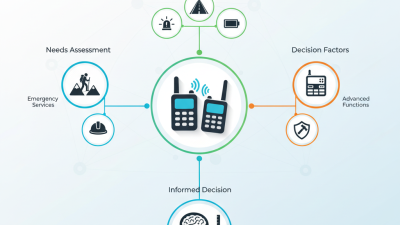
Choosing the longest range walkie talkie can be challenging. It requires careful consideration of various factors. First, the intended use greatly impacts your choice. Whether for outdoor adventures or professional purposes, the range and battery life are crucial.
Many devices promise extended range, but not all live up to expectations. Environment plays a significant role in performance. Hills, buildings, and trees can dramatically reduce communication distance. Look for features like adjustable frequencies to enhance clarity.
Researching reviews and expert opinions helps narrow down options. Reliable brands often have a history of satisfying customers. However, not all recommendations suit your specific needs. It’s essential to reflect on your unique situation. Ultimately, selecting the longest range walkie talkie should align with your requirements and preferences.
Understanding Walkie Talkie Range and Its Importance
Understanding the range of walkie-talkies is crucial for effective communication. The term "range" often refers to the maximum distance a device can transmit signals. Various factors influence this range, including terrain, weather conditions, and obstructions like buildings. Reports from the American National Standards Institute suggest that typical ranges can vary dramatically, from under one mile in urban areas to over 30 miles in open fields.
The effective use of a walkie-talkie relies on understanding these limitations. Environmental obstacles significantly reduce the actual range. For example, dense forests or urban settings can cut down the effective range by up to 90%. Thus, consider your surroundings when selecting a walkie-talkie for remote work, hiking, or emergency situations.
Tips: Always test devices in real-world conditions. Assess how different terrains affect connectivity. If possible, communicate with your devices' limitations in mind. Look for reviews that touch on real-use cases, not just theoretical distance. The ideal device is one that performs well for your specific needs, rather than purely based on maximum range. A balance of desired range and reliable performance is necessary to ensure effective communication in various scenarios.
Factors Affecting Walkie Talkie Range Performance
When selecting a walkie-talkie, the range is a critical factor influenced by various elements. Stationary obstacles such as buildings, trees, and hills can significantly reduce the effective range. According to a report from the Federal Communications Commission (FCC), terrain can diminish signal reach by as much as 67%. Understanding these variables can improve your choice.
Additionally, the frequency band of a walkie-talkie plays a vital role in its performance. Low frequencies penetrate obstacles more efficiently, while high frequencies can cover greater distances in open spaces. Research indicates that UHF frequencies typically offer better performance in urban areas compared to VHF. However, UHF signals may struggle in dense forests, where VHF excels.
Battery life also affects the communication range. A full charge allows for optimal signal transmission, while a weak battery can lead to signal dropouts. Studies show that battery power can influence communication range by over 20%. Selecting devices with robust battery life and backup options can help ensure consistent communication in critical situations. These factors highlight the importance of considering specific needs when choosing a walkie-talkie for effective communication.
How to Choose the Longest Range Walkie Talkie for Your Needs? - Factors Affecting Walkie Talkie Range Performance
| Factor |
Description |
Impact on Range |
| Terrain |
The geographical features (hills, buildings, forests) around the area of operation. |
High impact; rugged terrain can greatly reduce range. |
| Frequency |
The operational frequency (VHF, UHF) of the walkie talkie affects its ability to penetrate obstacles. |
Significant impact; lower frequencies generally have better range. |
| Power Output |
The amount of power the walkie talkie transmits signals with. |
Directly proportional; higher power output can extend range. |
| Antenna Type |
The design and length of the antenna can affect signal transmission and reception. |
High impact; better antennas can enhance range. |
| Obstructions |
Buildings, trees, and other obstacles that block line of sight. |
High impact; can severely hinder communication. |
| Weather Conditions |
Rain, fog, and snow can affect the radio waves. |
Moderate impact; bad weather can reduce range. |
| Battery Life |
The capacity and health of the walkie talkie's battery. |
Indirect impact; a weak battery can reduce performance. |
Types of Walkie Talkies Based on Range and Features
When choosing a walkie-talkie, range and features are crucial factors.
Devices can be classified broadly into FRS (Family Radio Service), GMRS (General Mobile Radio Service), and commercial-grade units.
FRS walkie-talkies typically offer a range of 0.5 to 2 miles.
In contrast, GMRS models can reach up to 20 miles, given they operate on higher power levels.
According to the FCC, users should note that GMRS requires a license for operation, which doesn’t apply to FRS devices.
Commercial-grade walkie-talkies, designed for businesses, often exceed the typical range of consumer units.
They feature advanced functionalities like noise cancellation and weatherproofing.
However, users may find these units expensive.
Reports indicate that commercial devices can cost anywhere from $200 to $1,000, depending on their specifications.
Such considerations can pose challenges when balancing budget and functionality.
It's important to reflect on your specific needs.
For casual users, FRS models may suffice.
Yet, if your work involves rugged environments or longer distances, investing in GMRS or commercial-grade options could be wise.
When selecting, also consider factors like battery life and durability.
Users often overlook the impact of terrain on range; mountains and buildings can significantly reduce effective distance.
Assessing Your Communication Needs for Specific Environments
When choosing the longest range walkie-talkie, clarify your communication needs for specific environments. Different settings—like mountains, forests, or urban areas—affect signal strength. For example, thick trees can block signals. Buildings can create dead zones. Understanding these factors is essential.
Consider the distance required for your activities. A walkie-talkie might have an impressive range on paper, but obstacles can hinder performance. Evaluate your typical surroundings. If you often walk through challenging terrains, select a model designed for those conditions.
Don't forget the group size and usage frequency. Frequent use means battery life matters. Sometimes, a shorter range option with superior battery and clarity is better. Assess your priorities and needs. Reflect on past experiences. This will guide your decision more effectively.
Comparing Popular Models for Long-Range Walkie Talkies
Choosing a long-range walkie talkie involves understanding your needs and comparing popular models. Different models excel in various environments, such as urban or rural. For instance, certain walkie talkies perform well in dense areas with tall buildings, while others might shine in open, remote locations.
Battery life is crucial. Some models boast impressive longevity, lasting over 20 hours. In contrast, others may fizzle out after just a few hours. It’s essential to assess how often you will use the device and choose one with sufficient battery life for your activities. Communication clarity also varies widely among models. Some offer noise reduction, while others may struggle with static.
User feedback often highlights the importance of ease of use. While some devices feature intuitive interfaces, others can be convoluted. A complicated walkie talkie can lead to frustration in critical moments. Additionally, it's worth noting that range specifications can vary based on conditions. Testing the walkie talkie in your intended environment can yield insights that specifications might not fully capture.